
Asking for What You Need in a Relationship: Why If You Loved Me, You’d Know Backfires
Sep 13, 2026
You are not broken. You are speaking different languages. The Affinity Consultants couples communication workshop uses the Process Communication Model (PCM®) to show you and your partner exactly why your conversations keep going sideways and what to do about it. In a single workshop session, couples learn to identify each other's communication personality type, recognize the patterns that trigger shutdown and escalation, and practice specific techniques for getting through to each other. Workshops are available in-person in Wichita, Kansas.

PCM® Couples Workshop is for couples, married and unmarried, who desire to deepen their connection and communication with one another.
This 1 day workshop is designed to help couples recognize each other's unique gifts, patterns of communication, psychological needs, and ways to negotiate conflict in healthy ways. The workshop unpacks each person's unique personality in order to have a better understanding of how you perceive the world around you, communication style, patterns of miscommunication, and how to work through times of disconnect and miscommunication.
Each partner will gain a greater understanding of their unique personality patterns in order to have better clarity of strengths and areas of weakness regarding communication. This knowledge will allow for a greater use of tools to use in solving miscommunication, being more proactive in self-care and stress management.
We will provide personalized feedback and support using research-based information provided by the Process Communication Model® (PCM®) assessment. Each person will receive their own individualized profile. Each couple will receive individualized coaching throughout the day and share only what they choose.


"PCM® has helped us to understand the difference in personalities. But our superpowers within our own personalities help to fill in the gaps for each other and balance the relationship. We have had to learn and put into action steps to avoid conflict that we can easily slip into simply by miscommunicating. It has helped us to understand what to look for, and what it means for the other person to be in distress."
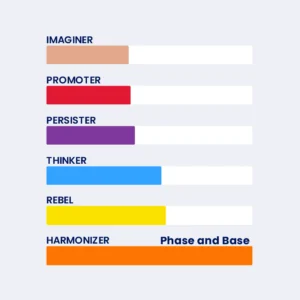
Each partner completes the PCM® personality assessment online (~30-45 min). It reveals your unique structure: your base type, your phase type (which drives your current needs), and your stress patterns. You arrive at the workshop already knowing your profile.

The workshop begins with your own results. Learn what your type needs from a conversation, how you respond when those needs go unmet, and what your partner sees when you go into distress. This is often the first moment couples say "that explains so much.
Explore your partner\'s profile. Learn what they need to feel heard, how to recognize when they are entering distress, and exactly what communication channel to use to reach them. The framework becomes practical; you are learning about the specific person you share your life with.

Hands-on practice with real scenarios from your relationship by going through conversations that always go wrong using the PCM® framework. Matt or Sarah coach in real time, helping you recognize patterns as they happen and try different approaches until you find what works.

Leave with your PCM® profiles, a communication reference guide, and specific action steps for applying what you learned at home. Most couples report noticing changes in how they communicate within the first week.

Couples who attend receive their comprehensive PCM® Profile. It is a comprehensive, research-based tool that identifies each person's unique personality structure, offering insights into how you perceive the world, engage with others, and react to stress.
The workshop will go through the process of decoding you and your partner's communication styles and teaching you how to communicate better using PCM®.
Example of a PCM® Personality Structure

It is never really about the dishes. Or the money. Or who forgot to text back. The fight that keeps repeating itself in your relationship has nothing to do with the topic and everything to do with how you and your partner are communicating about it.
Each of you has a dominant communication personality type. Your type determines what you need from a conversation in order to feel heard, respected, and connected. When your partner speaks in a style that does not match your needs, their words bounce off or get distorted. You hear criticism when they meant concern. They hear indifference when you meant calm.
Over time, these mismatches create predictable patterns. One person pursues; the other withdraws. One gets louder; the other shuts down. Both of you walk away feeling unheard, and the cycle repeats next week with a different topic but the same dynamic.
PCM® breaks this cycle by giving both of you a framework for understanding what is happening and specific tools for responding differently. It is not about changing who you are. It is about learning how to reach the person sitting across from you.
The couples communication workshop gives you more than insight, it gives you tools you can use the same night you get home. Here is what you will walk out with:
PCM® maps predictable distress sequences for each personality type. You will learn to spot the early warning signs before a conversation escalates, giving you time to change your approach.
Each personality type has a preferred communication channel. When you use the right one, your partner actually hears your message instead of reacting to your delivery.
It is not the topic. It is the combination of stress and communication mismatch. You will learn to separate the issue from the pattern, so you can address both.
Even with new tools, you will still have hard moments. PCM® teaches you how to reconnect after a rupture using your partner's specific needs.
Practical couples communication exercises designed for your specific personality type combination. Not generic advice; tools built for the two of you.
A comprehensive, multi-page assessment that maps both partners' personality structures, communication channels, distress sequences, and environmental preferences.
These are not abstract concepts. Every tool is practiced during the workshop with coaching from Matt or Sarah, so you leave knowing how to use them.
What you see on the surface: the raised voice, the silent treatment, the sarcastic comment is only the visible layer. Underneath, each personality type has a distress sequence: a predictable path from over-adapting drivers into full mask behaviors. These map directly onto the fight, flight, freeze, and fawn responses you already know from your own body.
Your partner over-adapts; agreeing with everything, suppressing their own needs, swallowing anger to keep the peace. They laugh at things that are not funny, say "it's fine" when it is not, and bend themselves into shapes trying to make you happy.
The cost: the anger they internalized turns inward. They withdraw, become unreachable, and get rejected by the very partner they were trying so hard to appease.
Goes quiet first; analysis paralysis, trying to think their way out of the conflict. They retreat into their head, processing silently while you interpret their silence as indifference.
The flip: when freeze fails, they go rigid and over-controlling. Suddenly everything you do is careless or wrong. They are not attacking you; they are trying to impose order on chaos. But it lands as contempt.
Starts with righteous frustration; lecturing, scolding, pushing harder. Every conversation becomes a courtroom where they are the prosecutor and you are on trial. Why won't you just see that I'm right?
The retreat: if you push back, suspicion mounts. They pull away entirely, convinced you cannot be trusted. The distance feels punitive because, for them, it is protective.
Avoids emotional intimacy altogether. When vulnerability threatens, they create distraction; picking a fight about something unrelated, making impulsive plans, stirring up drama. Accountability feels like a trap.
The bind: you feel like you can never pin them down for a real conversation. They feel like you are trying to cage them. Both of you are right.
Meets tension with deflection and blame; sarcasm, eye-rolls, and "whatever." When things get heavy they get flip, turning the conflict into someone else's fault so they never have to sit in the discomfort.
The dodge: the humor and blame keep the real issue at arm's length. You feel dismissed; they feel cornered. Nothing gets resolved because nothing gets faced.
Disappears inward, going quiet and still, waiting for direction that never comes. Overwhelmed by the noise of conflict, they shut the door and wait for the storm to pass.
The vanish: their silence reads as not caring, so you push harder, which drives them further inside. The more you pursue, the less of them is there.

If you just read one of those and thought "that is exactly what happens in our house," you are not alone. The topic of the fight changes. The pattern does not.
Most couples focus entirely on what they say during important conversations. Almost no one thinks about where they say it. Personality type determines not just how you communicate best; it determines the physical environment where you communicate best. Get the environment wrong, and the conversation is set up to fail before anyone opens their mouth.
A quiet conversation at home, on the couch, with warm lighting and no distractions. Loud restaurants drain them; they cannot access emotional depth in noise.
If the house is chaotic with kids, the TV on, dishes piled up, they cannot think clearly enough to engage. They shut down because their brain literally cannot work in that setting.
Sitting across from each other at the kitchen table feels like a sentencing hearing. Go for a walk, put on music, do something active, and suddenly they are present.
Long, stationary heart-to-hearts feel like being trapped. Keep it moving, keep it brief, give them something to do with the insight, and they will hear you.
They need a setting that signals the conversation is being taken seriously: no interruptions, no multitasking, time to make their case and to hear yours.
They need quiet space and time to process internally before they respond. Put them on the spot in a busy room and they disappear inward.
When couples have important conversations in the wrong environment for one partner's type, both end up frustrated and neither understands why. The workshop helps you stop accidentally sabotaging your own conversations.
If the word "workshop" makes you think "therapy lite," let us be clear about the difference. Therapy focuses on emotional processing, relational history, and deep pattern work over multiple sessions with a clinician. A communication workshop teaches you a skill set: you learn a framework, practice it together, and leave with tools you can use that night.
Many couples who attend are not in crisis and are not considering separation. They just know their communication could be better and want to do something about it before small problems become big ones. Others come because a therapist recommended building communication skills as a foundation for deeper work. Either way, this is a proactive step, not a last resort.
Have a question we haven't answered? Matt or Sarah will reply personally within 24 hours.
Contact Us arrow_forward