The Process Communication Model: 6 personality types that explain how people communicate
The Process Communication Model (PCM®) is a research-backed communication framework that identifies six personality types in every person. Developed by clinical psychologist Dr. Taibi Kahler and used by NASA to select and train astronauts, PCM® goes beyond labeling. It teaches you exactly how to communicate with anyone by understanding what they need to hear and how they need to hear it. Over 40 years of research and real-world application have made PCM® one of the most practical communication tools available for relationships, parenting, leadership, education, and clinical practice.
From clinical research to NASA
Dr. Taibi Kahler developed the Process Communication Model in the 1970s through his research into personality types and communication patterns. His work caught the attention of NASA, which contracted Dr. Kahler to develop a system for selecting astronauts and improving crew communication during high-stress missions.
Dr. Kahler identifies six personality types and their communication patterns through clinical research.
NASA contracts Dr. Kahler to develop astronaut crew selection and communication tools.
PCM® expands into corporate leadership, clinical therapy, education, and law enforcement across 50+ countries.
PCM® is used by couples, families, teams, clinicians, educators, and first responders worldwide.
That NASA application validated PCM® in one of the most demanding environments on earth. The logic was straightforward: if you are putting people in a confined space under extreme pressure, you need to know how each person communicates, what they need under stress, and how to prevent communication breakdowns before they happen.
Everyone has all six — in a unique order
Every person has all six personality types, arranged in a unique order called your "condominium." Your base type (the ground floor) is your primary communication style, but you can access all six types throughout the day depending on the situation. Understanding the full structure, not just a single label, is what makes PCM® actionable.
Thinker
Core need: Recognition for work and logical thinking. Thinkers process information through data, structure, and organized reasoning. They communicate best through a channel that is calm, factual, and organized. Under stress, they may over-control details or become rigidly focused on being "right."
Harmonizer
Core need: Recognition as a person and for warmth. Harmonizers lead with feelings, empathy, and relational connection. They communicate best through a compassionate, personal channel. Under stress, they may make mistakes, over-adapt to please others, or invite criticism.
Persister
Core need: Recognition for opinions and convictions. Persisters value integrity, commitment, and principled action. They communicate best through a values-based, opinion-sharing channel. Under stress, they may become rigidly judgmental or push their beliefs onto others.
Rebel
Core need: Playful contact and fun. Rebels bring creativity, spontaneity, and humor to every interaction. They communicate best through a playful, energetic channel. Under stress, they may blame others or disengage with sarcastic commentary.
Imaginer
Core need: Solitude and time for reflection. Imaginers are introspective, calm, and thoughtful. They communicate best through a directive channel where someone gives them clear, gentle instructions. Under stress, they may withdraw, become passive, or wait to be told what to do.
Promoter
Core need: Excitement and action. Promoters are direct, resourceful, and action-oriented. They communicate best through a brief, bottom-line channel. Under stress, they may manipulate situations, create unnecessary drama, or take reckless risks to generate excitement.
Each of these types communicates differently, needs different things under stress, and responds to different approaches. The power of PCM® is that once you know someone's type, you know exactly how to reach them.
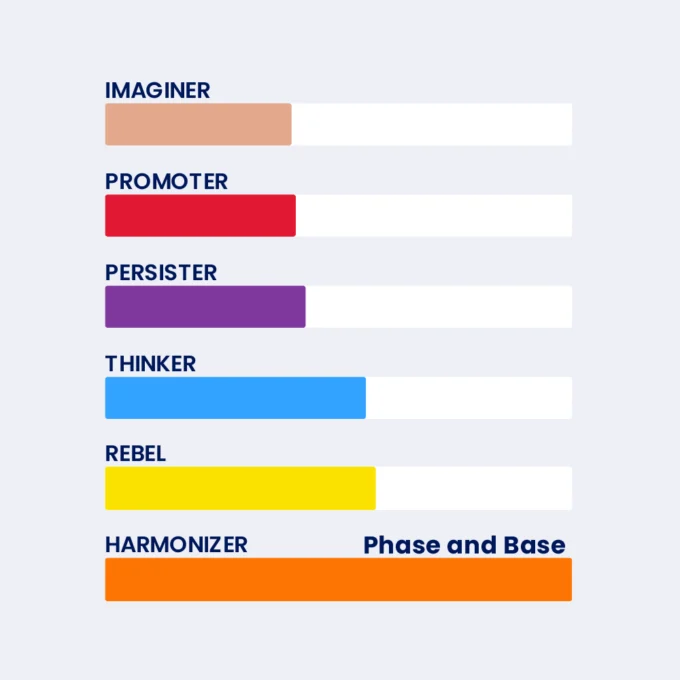
All six types, stacked inside you
Your PCM® condominium is the unique arrangement of all six personality types within you. Think of it as a six-story building: your base type is the ground floor (your dominant communication style) and the other five types are stacked above in a specific order. You can access all six floors, but you "live" primarily on the lower floors.
The order determines your communication strengths and stress vulnerabilities. Your phase type (which may differ from your base) drives your current psychological needs and can shift over time, often in response to significant life events. PCM® accounts for this dynamism; it is not a static label but a living model of how you communicate.
Beyond DISC, MBTI, and Enneagram
PCM® is not just another personality test. The critical difference is what happens after you get your results.
DISC tells you someone is "dominant" or "steady." PCM® tells you exactly what to say to that person when they are stressed, what communication channel to use in a meeting, and how to give them feedback they will actually hear.
MBTI categorizes you as one of 16 types. PCM® shows you all six types within you, in what order, and how to flex between them depending on who you are talking to.
Enneagram maps your growth path and core motivations. PCM® maps your communication channels and stress behaviors, giving you tools for every conversation, not just personal development.
| Feature | PCM® | DISC | MBTI | Enneagram |
|---|---|---|---|---|
| Types / Categories | 6 types | 4 | 16 | 9 |
| Focus | Communication + stress | Behavioral style | Preferences | Core motivations |
| Actionability | Specific tools | General awareness | Type description | Growth framework |
| Dynamic model | Yes (all 6 in order) | No (primary) | No (one of 16) | Partially (wings) |
| Stress patterns | Detailed sequences | Limited | Limited | Yes |
Where other frameworks stop at description, PCM® gives you prescription — specific, actionable techniques for every conversation.
From questionnaire to real change
The PCM® assessment is an online questionnaire that takes 30 to 45 minutes to complete. It produces a detailed personality profile that requires interpretation with a certified trainer. Your profile does not just label you, it gives you and your trainer a roadmap for improving specific communication relationships in your life.
Take the Assessment
Complete the online questionnaire (30–45 minutes). Reveals your base type, condominium order, phase type, communication channels, and stress patterns.
Review With Matt or Sarah
Your multi-page profile is interpreted in a session with a certified PCM® trainer who helps you understand what your results mean for your real relationships.
Apply in Your Life
Use your profile as a reference for adapting your communication with your partner, children, team, or anyone you interact with regularly.
Unlike free personality quizzes, the PCM® assessment produces a detailed, multi-page profile with specific communication tools, not just a label. It is a starting point for real change.
One framework, applied everywhere
PCM® is applied wherever communication matters. When you understand how someone needs to receive communication, you can reach them.
Common questions about the model.
Everything from the science behind PCM® to how the assessment works.
Which type leads your condominium?
Request the full PCM® assessment for a complete personality profile with interpretation. Either way, you are taking the first step toward understanding how you communicate and why.