
Why Do I Keep Having the Same Fight With My Partner? Understanding Distress Patterns

Episode 3: Behind the Therapy Door
This article draws on a conversation between therapists Sarah Thome and Matt Gallagher. Listen to the full episode for the stories behind the takeaways.
You can feel it coming. The tension builds, the same words come out, and before you know it, you are right back in the same argument you had last week, last month, or last year. Recurring relationship conflict follows patterns you can learn to see coming, the way Red on That ’70s Show hears “How does this dress look on me?” and answers, “Then what we’re going to do is, we’re going to fight.” Licensed therapists Sarah Thome and Matt Gallagher use the Process Communication Model® to make those patterns visible.

Related: What is PCM®?.
What Are Distress Drivers and Why Do They Control Your Arguments?
The Process Communication Model® identifies predictable distress behaviors called “drivers.” These are subtle, automatic shifts that happen in a fraction of a second when stress begins to build. You probably do not even notice your own. But your partner does.
For Harmonizer types, the driver centers on wanting to please people, which looks like over-accommodating, apologizing unnecessarily, and saying yes when you mean no. Persister energy wants stability and order, and wants to trust the people around it to handle their own stuff. Under stress, it meets timid, over-apologetic energy with friction: “Just say what you mean.” Put the two together and the more one apologizes, the more frustrated the other can get.
Related: How PCM® differs from the Gottman Method.
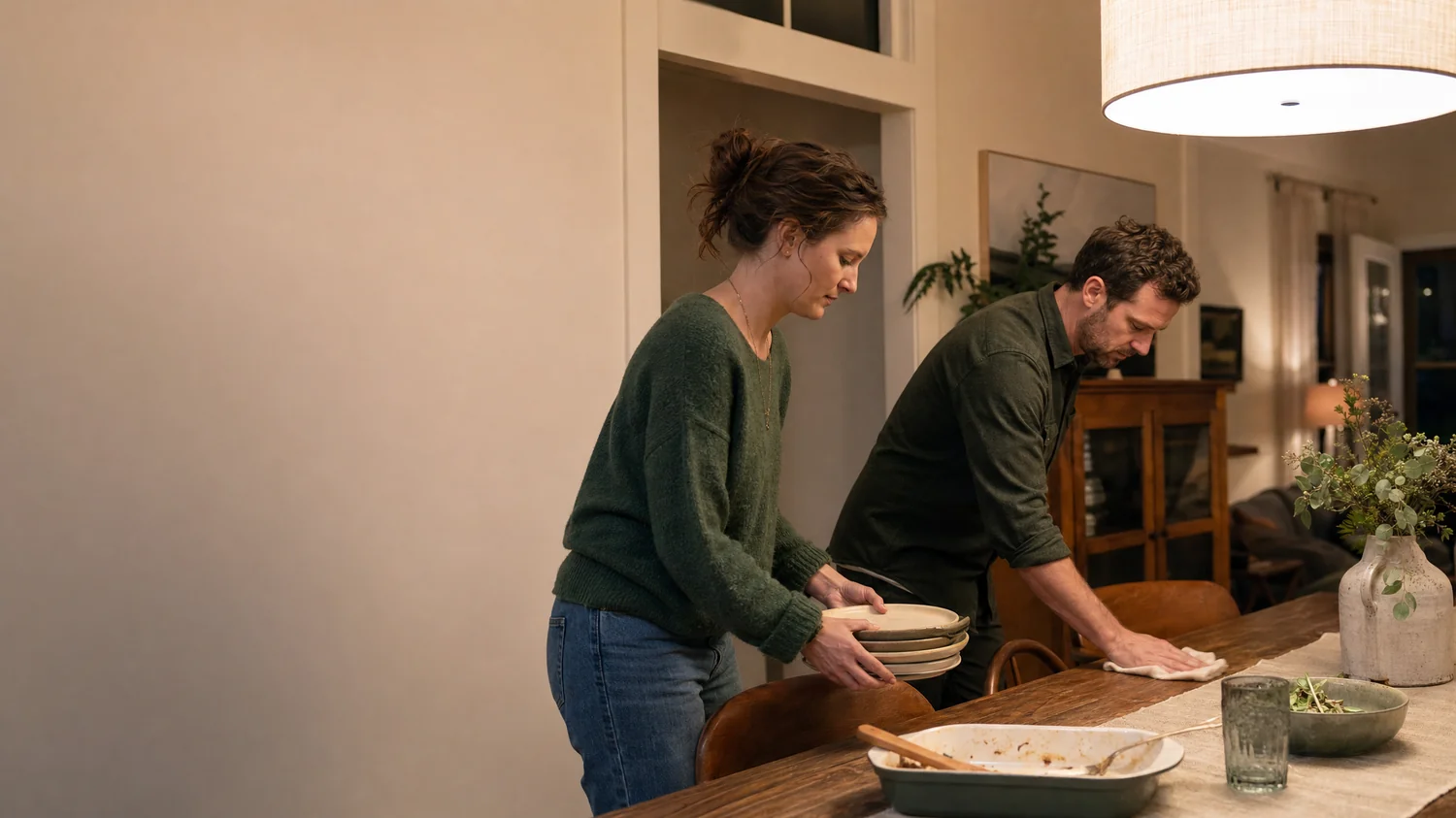
What Does This Look Like in a Real Kitchen on a Real Thursday Night?
Matt describes his Thursday evenings honestly. By the end of the week, he is tapped out. Everything drops to base level, with no warmth and lots of “leave me alone” energy. His wife, a base Harmonizer, has learned to read the signals. Instead of pushing for connection, she gives him permission: “Go out to the backyard with your fire pit and a cigar.” Acceptance and permission are exactly what his distress needs.
“When you try to grab your needs out of the middle of the table and take from the other person, nobody gets their needs met.”
Matt Gallagher, Behind the Therapy Door
The same principle applies to other types. Sarah’s husband is a base Thinker: logistical, organized, efficient. When he is pulled in too many directions and cannot finish tasks, he comes home a little irritable. Knowing where that comes from, she gives him more grace and patience and does not bombard him with honey-do’s. That knowledge is life-changing.
“The words can remain the same, but the intention behind them is different because you’re aware.”
Sarah Thome, Behind the Therapy Door
Related: Communication strategies for couples.
How the Process Communication Model® Predicts Recurring Relationship Conflict
PCM® gives you more than “communicate better.” It names the driver, the split-second distress that shows up first, so you can catch it early and meet the other person’s need instead. Take “What’s wrong?” Said in a stern voice that ends down, it can start a fight. Said softer, with looser posture and a more open face, the same words land as care.
PCM® trainer Nate Regier describes six keys, and the model tells you which key to use in the lock. Use the wrong one and you break it off. At her first PCM® training, Sarah politely asked Nate to refill the restroom toilet paper and got a flat “No.” Switching to his Promoter language, “Hey Nate, the toilet paper is out. Handle it,” got “On it.”
Related: Compare PCM® to DISC for relationships.
How Can You Identify Your Own Distress Driver?
- Notice your automatic response when stress builds. Do you apologize more? Get quieter? Talk faster? Get impatient with people who will not just say what they mean? Those shifts are your early warning.
- Ask your partner what they see first. We are usually the last to notice our own driver. Your partner has been watching it for years.
- Have the conversation outside of conflict. Sarah recommends asking each other: “When you are upset, what do you need?” when things are calm. Quiet time? A hug? To be asked one question and then left alone?
Related: Take the PCM® assessment.
Why Awareness Changes Everything
If you can see the conflict coming, you can choose otherwise. Asking the other person what they need, or stating your own, interrupts the automatic pattern. Instead of sliding into an argument neither of you intended, you create a new path.
Frequently Asked Questions
Why do my partner and I always fight about the same things?
Recurring arguments happen because both partners have predictable distress patterns that get activated by the same triggers. The Process Communication Model® calls these patterns “drivers.” Until you recognize your own driver and your partner’s, the cycle repeats automatically. Awareness of these patterns is the first step to interrupting them.
What is a distress driver in PCM®?
In PCM®, a driver is a subtle distress that happens in a fraction of a second. It is a distorted version of your usual behavior: your gifts, exaggerated. For a Harmonizer, kindness and sensitivity can turn into over-accommodating, saying yes when you need to say no, and apologizing for taking care of yourself.
Can we really stop having the same fight?
You can at least stop sliding into it on autopilot. When both partners understand their own distress patterns and each other’s through the Process Communication Model®, they can step in early. On a good day, ask each other, “When you’re upset, what do you need?” The answers might be quiet time, a hug, or one question and then being left alone.
Ready to Communicate Without the Same Old Fight?
Learn your exact distress pattern and your partner’s. Our couples workshop gives you the map to stop the cycle.