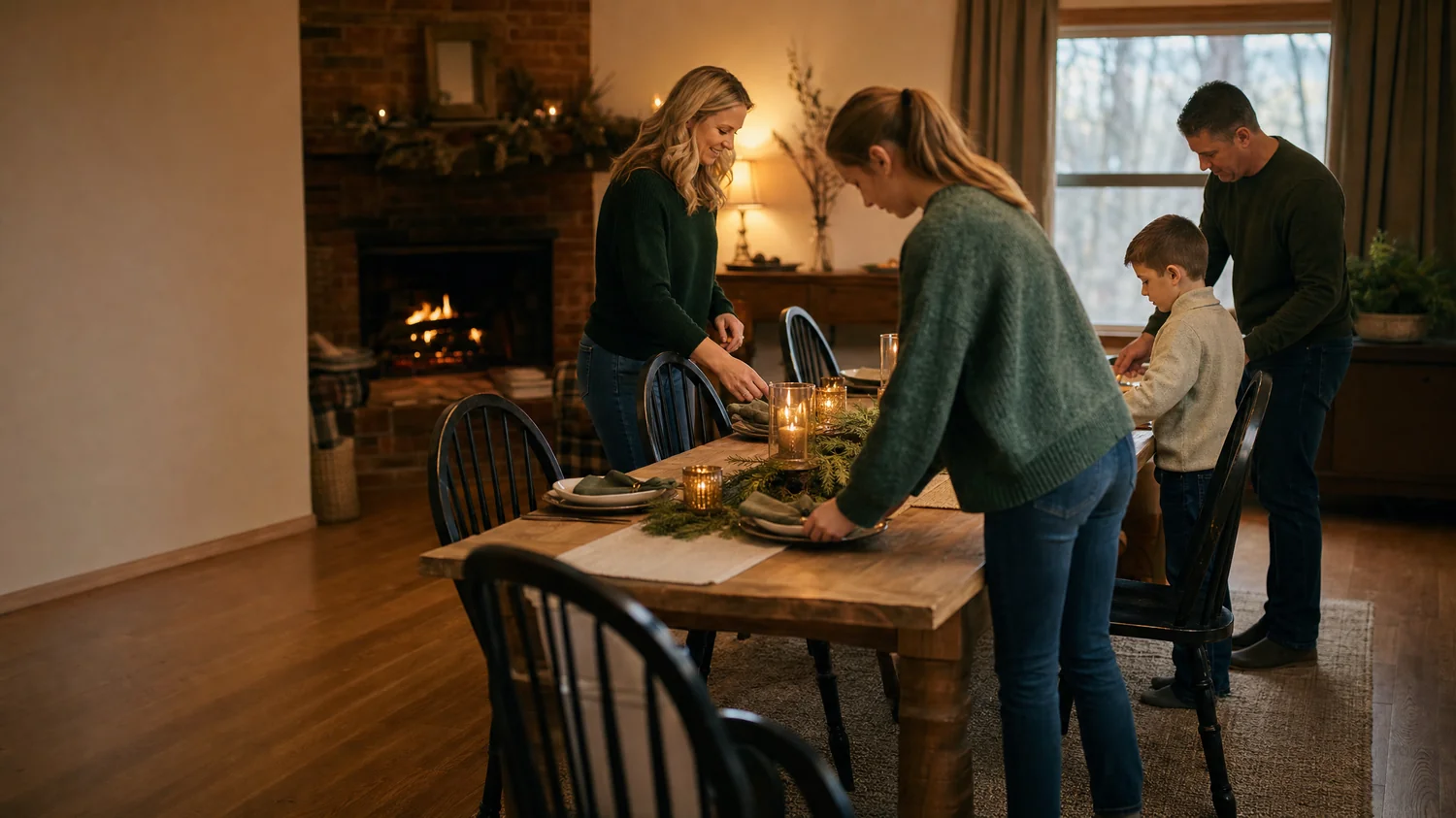

How to Navigate Family Drama During the Holidays Without Losing Your Mind

Episode 30: Behind the Therapy Door
This article draws on a conversation between therapists Sarah Thome and Matt Gallagher. Listen to the full episode for the stories behind the takeaways.
The holidays are supposed to be magical. Instead, you are sitting at a table with relatives who hold opposing political views, a parent who critiques everything, a sibling who still treats you like you are twelve, and a simmering argument about whose turn it is to host that has been going on since 2019. Family is complicated, and the holidays put all of it at one table. Here is how to hold boundaries with grace, make room for grief, and build traditions of your own.

Related: Understanding communication patterns.
Why Is Creating Your Own Holiday Traditions a Sign of Healthy Development?
Many people feel guilty when they want to change holiday routines. Skipping the big family dinner, starting a new tradition with your own partner and kids, or choosing not to travel feels like a rejection of the family you came from. It isn’t. Creating your own traditions is part of growing up, a gentle differentiation rather than abandoning your family of origin. Many young adults describe the first year they tell Mom and Dad, “We’re not going to be there on Christmas Day,” as a major coup. Be honest that it is a grieving process for parents, too.
This is especially difficult for the sandwich generation: adults caring for aging parents while raising their own children. The pull in both directions is constant. Add the busyness of the holidays and it gets overwhelming. Ask what you can delegate and who can help, and build in self-care to pace the demands. If a parent who has always hosted is slowing down, offer to bring two or three dishes and have siblings or cousins pitch in. If a parent isn’t comfortable coming over, have your traditional meal and bring them a plate.
Related: PCM® workshop for parents.
How Does PCM® Explain Why Holiday Family Conflict Pushes Your Buttons?
Persister energy is a big one. If everyone walks into the room pretty sure they’re right, and you haven’t been sharing life with each other, that is a recipe for holiday awkwardness. When you see family once or twice a year, you may also be frozen in time in their minds, which is why little comments about weight or gray hair sting. Families with a lot of Persister energy can struggle to share holidays, too: “You mean it’s not the way I want it?”
We can still be grateful that we even have people who love us enough to want to spend time with us.
Sarah Thome, Behind the Therapy Door
Some family quirks become the best part of the holiday. When Sarah and her husband first started dating, she warned him that her grandmother (now 103) would play Christmas carols on a real organ during the family dinner, loudly enough that nobody could carry on a conversation. When Sarah warned her future husband, he said it wasn’t going to happen. Then the carols started in the middle of a conversation with her aunt and uncle. They still laugh about it every year.
Related: PCM® vs MBTI.
Related: PCM® vs Enneagram.
What Is the Best Way to Handle Contentious Topics at Family Gatherings?
Have a phrase ready before you sit down: “Hey, I love you too much to talk about that contentious topic.” Family makes it easy to get pulled in, because it feels like you can talk about anything with your sister or your dad. You do love each other, but if you’re really misaligned, you don’t have to take the bait. Or get curious instead: “Help me understand what you’re wanting out of this conversation, because I don’t think we’re going to see eye to eye.”
Gifts come with their own politics. Thank-you notes can sometimes feel like the gift created an obligation, so if you’re exchanging gifts in person, say your thanks right then and there. Keep gifts fair, too. In blended families especially, one kid getting an Xbox while another gets socks is just hurtful. And stay out of the power struggle over who gave what and who is more appreciated.
Related: Couples communication workshop.
Related: About Sarah and Matt.
It’s easier to cast judgment or have strong opinions when you have less data to complicate the story.
Matt Gallagher, Behind the Therapy Door
How Do You Navigate Holiday Grief When Someone Is Missing From the Table?
Holiday grief is a category of pain that people rarely talk about openly. The empty chair. The recipe nobody makes anymore. The ornament that belonged to someone who is gone. The first holiday after Sarah’s dad died, her family took a fall getaway. Sitting on a bluff overlooking the Ozarks, she wore one of his flannel shirts and drank coffee, because he loved both, and invited him and his energy into the moment. It doesn’t have to be grand: a favorite meal, a dessert, a carol, or a story, like how terrible her dad was at Taboo.
One church Matt noticed hosted a “Blue Christmas” for exactly this reason: when family gathers, anyone missing is felt more. Give yourself permission not to participate fully. If you can handle one small gathering and then need to go home, that’s okay. Honoring the loss beats pretending nothing happened. The grief poem “Take Me With You” puts it as a question: how do we bring our loved ones with us when they’re gone?
Sarah calls National Lampoon’s Christmas Vacation the best Christmas movie ever, a movie that endures because it tells the truth about holiday family dysfunction wrapped in comedy. Clark Griswold’s desperate pursuit of the perfect Christmas is every person who has ever tried to manufacture joy through sheer force of will. The movie works because audiences recognize themselves in the chaos. The “perfect holiday” is a myth. The real holiday is messy, imperfect, and held together by people who keep showing up despite all of it.
Related: Best communication assessment.
Related: PCM® profile assessment.
What Does “Blood Is Thicker Than Water” Really Mean for Modern Families?
Some people live by “Blood is thicker than water.” Others say, “Friends are the family you choose.” Both hold some truth. For many people, friendships become a true family bond, and chosen family often gets more deliberate care because it is a priority. Family of origin is the dependable one: when there’s a crisis, you call family. The risk is taking them for granted.
So set boundaries with grace, and lean into gratitude. Take the good from your family and try to unlearn the bad. When someone gets on your nerves, ask yourself, “What’s at least one positive?” Even with tough personalities at the table, you still have people who want you there.
Related: Workshops and training.
Related: Contact us.
Frequently Asked Questions
How do I set boundaries with family during the holidays?
Use language that affirms the relationship while naming the limit. Sarah’s phrase “I love you too much to talk about that contentious topic” works because it leads with warmth. Avoid clinical boundary-setting language with family members who will hear it as rejection. The goal is to protect the relationship and your peace simultaneously.
Is it okay to skip family holiday gatherings?
You can give yourself permission not to participate fully. If you can only handle one small gathering, or a couple of hours before you head out, that’s okay. Creating your own traditions is a healthy part of growing up, and alternating Thanksgiving and Christmas between families keeps things fair.
How do I handle holiday grief when everyone else is celebrating?
Give yourself permission to feel the loss without performing joy. Rituals help: wearing a loved one’s clothing, visiting a meaningful place, or attending a Blue Christmas service designed for people who are grieving during the holidays. You do not have to choose between honoring your grief and participating in celebration. Both can coexist.
Why do small disagreements become huge fights during the holidays?
When you see family once or twice a year, everyone walks in pretty sure they’re right without having shared much life in between. You may still be frozen in time in their minds, so small comments land hard. Add the passive-aggressive jab from someone who says they don’t want to fight, and small things flare fast.
What does “chosen family” mean and is it valid?
Chosen family refers to the people you select as your inner circle based on mutual support, shared values, and consistent presence rather than biological connection. It is fully valid. Some people live by “Blood is thicker than water,” but many find that “Friends are the family you choose,” the people who show up consistently are family in every way that matters.
Reach the Kid You Actually Have.
Navigate family dynamics with confidence. Join our next parent workshop.